29 November 2008

Frida

A film by Julie Taymor

The story of an exceptional woman who lived an unforgettable life. Frida Kahlo, born in Mexico in 1907, endured a life of crippling pain caused by a road accident in her youth, yet her innate energy, passion and love of life, as well as her enormous abilities as a painter, allowed her to overcome this daunting obstacle to achieve fame and recognition. From humble beginnings, Frida Kahlo is a talented artist with a unique vision, and from her enduring relationship with her mentor and husband, Diego Rivera, to her scandalous affairs, Frida's uncompromising personality inspires her greatest creations. She is an artist in every sense of the word – taking and owning all that life gives her and transforming it into unflinching portraits of her soul.

Frida, in many ways, prides herself on her independent, fiery nature, yet when Rivera becomes a part of her life, she quickly succumbs to his seductive charms. She marries him even though she knows he is constitutionally incapable of remaining faithful to her. She accepts this in the knowledge of what lies ahead for her since she is incapable of living without him. That the relationship is one of utter co-dependency is demonstrated by the fact that Rivera, even after their numerous breakups, keeps coming back to his one true love.

But we see also, and empathise with, the hypocrisy inherent in her own romantic dalliances, principally her bisexual flings with other women and even the affair she conducts with Trotsky himself during the period of his exile in Mexico, just before his assassination. Frida is a woman who experiences so many tragic things in life yet she never gives up, she in fact grows stronger, helped through hard times by her wit, her dignity and her love for life and art.

Between 1926, when she made her first self-portrait, and her death in 1954, Frida produced around 200 images. Certainly the biographical details of her remarkable life inflect many aspects of her work, yet her depiction of her body and experiences can also be seen as a response to wider cultural and political debates. For all their apparent naivety, her works frequently reveal an incendiary subtext, whether they are questioning power relationships between developed and developing nations, testing the role of women within a patriarchal society, or attempting to reconcile the global histories and religions of East and West.

Frida Kahlo's unique talent was to make her one of the century's most enduring artists. She is variously enshrined in the popular imagination as a bohemian artist, a victim turned survivor, proto-feminist, sexual adventurer who challenged gender boundaries, and, with her mixed-race parentage, an embodiment of a hybrid, postcolonial world.

Adapted from the biography by Hayden Herrera, the film is a marvellous tribute to a truly unique and remarkable woman, and one of the greatest female artists of the 20th century.

16 November 2008

Possession

A film by Neil LaBute

Roland Michell is a laid-back American scholar who has come to London to research the 19th century English poet Randolph Henry Ash. The present year, 2000, marks the centenary of the discovery of Ash's work. While examining a first edition of one of Ash's volumes, Roland discovers some original letters which hint at the possibility that Ash, contrary to the public impression of his marital fidelity, may actually have had an affair with another famed poet of the time, Miss Christabel La Motte, a woman believed by her biographers to have lived exclusively with her partner Blanche. Confronted with this startling, revolutionary and, perhaps, priceless piece of information, Roland sets out to unravel the mystery.

He enlists the help of the sceptical British academic Maud Bailey, an expert on the life and work of Christabel La Motte, and also a distant descendant. The two embark on a journey to unravel the truth surrounding the poets' forbidden love. But as Roland and Maud track the elusive romance across the British countryside to Lincoln and Whitby, the two scholars soon find themselves tangled in a love affair of their own.

The narrative moves seamlessly between past and present to portray the parallel love stories in this beautiful and passionate adaption of the Booker Prize winning novel by A S Byatt.

12 November 2008

Capturing Mary

A film by Stephen Poliakoff

This is the companion to Joe's Palace, set in the same exquisite empty house and is linked by the doorkeeper Joe through whose eyes we see the world.

When Joe opens the door to an elderly lady, she takes him back to a time when the house thronged with the glamourous and powerful – and to a time when she was young, beautiful and talented with the world at her feet.

As Joe takes her through the house Mary begins to relive her relationship with Greville White, a supremely charming man who seems to hold the rich and famous in the palm of his hand. Who was this enigmatic figure? Was he feigning friendship with Mary, but offering something much more sinister and frightening? In a dark and terrifying exploration of her youth, Mary relates a chilling story of a life captured and transformed.

Also included on the DVD is an exclusive prequel A Real Summer in which we see young Mary strike up an unexpected friendship with a young aristocrat Geraldine. An allegorical tale which explores the two aspects of Mary's personality, revealing in juxtaposition her aspirations, achievements and doubts, and the self-acknowledged warning that she will choose to ignore.

7 November 2008

Joe's Palace

A film by Stephen Poliakoff

The story takes place in the exquisite but empty Mayfair house of reclusive billionaire Elliot Graham, who lives a lonely life across the road. When Joe, the naive son of the cleaner, takes the job as the vacant house's doorkeeper, he and Elliot strike up a fledgling friendship.

Soon Joe is given the run of the house, exploring its many rooms and secrets, and providing a convenient refuge for a cabinet minister and his beautiful mistress to conduct a clandestine and passionate love affair.

The house seems to attract lonely people – the doorman whom Joe replaces, the housekeeper, the night security guard, both the cabinet minister and his mistress, the homeless man and Elliot Graham himself. Elliot is increasingly paralysed by his suspicions of the origin of his inherited wealth and when the secret is finally revealed, it is Joe who accompanies the billionaire on his disturbing and devastating journey.

4 November 2008

The Constant Gardener

A film by Fernando Meirelles, adapted from the novel by John le Carré.

British diplomat Justin Quayle meets the impulsive human rights activist Tessa when she heckles him after he has presented a lecture. When she learns that he is about to embark on a diplomatic mission in Kenya she proposes to him in order that she may accompany him as his wife.

In a remote area of northern Kenya, Tessa Quayle is found brutally murdered. Tessa's companion, Dr Arnold Bluhm, appears to have fled the scene, and the evidence points to a crime of passion. Members of the British High Commission in Nairobi assume that Tessa's widower, their mild-mannered and unambitious colleague Justin Quayle, will leave the matter to them. But haunted by remorse and jarred by rumours of his late wife's infidelities, Quayle surprises everyone by embarking on a personal odyssey that will take him across two continents.

Using his privileged access to diplomatic secrets, he will risk his own life, stopping at nothing to uncover and expose the truth – a conspiracy more far-reaching and deadly than Quayle could ever have imagined, involving members of the British High Commission and the sinister business practices of a leading multi-billion dollar pharmaceutical company. In the process of learning the secrets of his powerful enemies, Justin must uncover all of his wife's many secrets as well.

A very poignant and thought-provoking story of conspiracy, deception and treachery.

2 November 2008

The Lost Prince

A film by Stephen Poliakoff

It is 1910. One dynasty holds sway over the most powerful nations of the world, at its heart is the British monarchy and its youngest member, Prince John. A loving, insightful and humorous child, Johnnie is witness to some of the most momentous events in the history of our times. As a baby he is surrounded by the extravagant court of Edward VII and Queen Alexandra at the height of British imperial power. But as the Great War looms his newly crowned father George V and his mother Queen Mary become embroiled in the tumult of world affairs and do not have time to see their special child as he grows. He is prone to epileptic fits and the medical profession consider him to be an imbecile and as such an embarrassment to the family.

As the landscape of Europe changes forever Johnnie is looked after in a remote farmhouse in the Sandringham estate by his devoted nurse Lalla. Dedicating her life to the little boy she determines to remind the monarchy that Johnnie is, at heart, a true prince. A beautiful, moving and heartbreaking deconstruction of the stultifying haze of tradition, refinement and etiquette in which the Edwardian royals lived.

27 October 2008

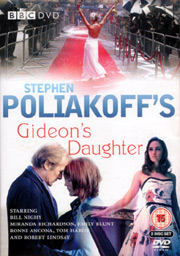
Gideon's Daughter

A film by Stephen Poliakoff

William Sneath, the character from Friends & Crocodiles reappears to narrate a powerful story of success, loss and redemption. "Here is a man who can't listen, and yet the more he doesn't listen, the more people want him, the more people believe in him. He's the toast of Whitehall, the flavour of flavours."

As the century draws to a close, a new Labour Government comes to power, and the death of Princess Diana heralds a summer of flowers. PR guru Gideon Warner finds himself in perfect step with the times and success seems easy as politicians, businessmen and starlets beat a path to his door.

But just as he reaches the pinnacle of his career, Gideon finds his life spinning out of control. When he should be organising the nation's Millennium celebrations, he is focusing on diffusing the implacable anger of his daughter Natasha. And, rather than shaping the business ambitions of an Italian media tycoon, his time is spent falling in love with the eccentric Stella – a mother grieving for her dead son.

Writer and director Stephen Poliakoff imparts an incredible tenderness matched with a hard-hitting candour to this moving story. The sister film to Friends & Crocodiles, it completes a brilliant panorama of the final decades of the last century.

25 October 2008

Friends & Crocodiles

A film by Stephen Poliakoff

The story traces the relationship of a maverick entrepreneur and his colleague over a period of 20 years. It follows the shifting power balance between them as their careers rise and fall through the changing corporate landscape from the beginning of the Thatcher years to the rise of the electronic age and the dot-com bubble.

It is 1981 and Paul Reynolds, a Gatsby-like figure, is the young, wealthy owner of a magnificent country house, a host of great parties, and the patron of eccentrics. He is a collector of interesting people, a visionary with dreams of new urban landscapes, wind power, airships and questions about why the crocodile has survived unchanged for two millennia.

He persuades Lizzie Thomas, a secretary at a local estate agents, to come and work for him as his assistant, to bring some order into his chaotic and hedonistic existence. Once at his country house her world expands – she meets academics, poets, artists, revolutionaries, libertarians and politicians. It is here that she first encounters Sneath, a social chameleon and born survivor, who is always there as events unfold and available to tell the story later.

Paul inspires Lizzie with his enthusiasm and imagination, and frustrates her with his apparent carelessness and destructiveness, which culminates in her calling the police as a great party is turned over by local troublemakers, seemingly with Paul's tacit approval. Paul's Eden seems destined to self-destruct – a terrible row ensues between them and they part company vowing never to speak or see each other again.

Some years later they do meet again, by chance, in London. Following this first awkward encounter their paths are destined to cross again and again as Lizzie, with the help of some of those she met at Paul's house, rises through the changing landscape of corporate Britain and Paul continues to pursue his dreams and create another Eden for himself.

Now that the seemingly unstoppable impetus to change, rationalise and modernise has taken root, technology and everyone is moving on – nothing is permanent or constant. However, eventually one certainty does become apparent and Lizzie and Paul come to accept that despite everything that has happened they were born to work together.

The story is an examination of the nature of personal relationships where work and ideas are more powerful drivers than sexual emotions. In his inimitibale style, Poliakoff combines cinematic panorama with moments of great intimacy as he takes an epic sweep through Britain's recent past and creates an unforgettable story.

10 October 2008

Close my eyes

A film by Stephen Poliakoff

Children of a broken marriage, Richard and his estranged sister Natalie meet up after years of being apart. He is a strident, ambitious urban planner, a yuppie with a hectic career and social life. She leads a dull and lonely life, stuck in a dead end office job. During their evening together Natalie becomes upset and looks to Richard for comfort, and during the night they share a moment of affection which strays a little beyond the usual physical closeness of siblings. Richard is surprised by these events and Natalie appears regretful, a little ashamed, and even more confused.

Their lives take them in separate directions once more. While Richard's career abroad fulfils both his professional and social needs, Natalie still feels lost, uncertain and unloved, and Richard's absence in her life becomes a focus for all she does not have and all that she needs.

Some years later Richard returns home, and rather surprisingly, takes a low-paid public sector job. Natalie, whom he has almost forgotten, gets in touch with him again and invites him to meet her new husband Sinclair, a millionaire futurologist – brilliant, very eccentric, kind and generous, but also child-like in his innocence and detachment from the world in which he has become such a success. Richard is clearly stunned by the new life his sister leads, a life which she appears not to have completely embraced. She is however now far more self-confident and begins to lure Richard as he again becomes the object of her affections.

Soon they embark on a forbidden and passionate affair. Richard falls in love with Natalie, and against the backdrop of a glorious British summer, their relationship intensifies as they struggle to accept the aftermath of their actions. Richard becomes gripped with infatuation for his sister and matters come to a head when Natalie's husband Sinclair suspects that his wife is having an affair, little knowing that the lover he is so jealous of is his wife's own brother.

6 October 2008

Iris

A film by Richard Eyre

The story of one of the most extraordinary women of the 20th century, the celebrated English author Iris Murdoch. As told by her unlikely soulmate, husband John Bayley, Iris first became known as a brilliant young scholar at Oxford whose boundless spirit dazzled those around her. During a remarkable career as a novelist and philosopher, she continued to prove herself a woman ahead of her time. Even in later life, as age and illness robbed her of her remarkable gifts, nothing could diminish her immense influence or weaken the bond with her devoted husband.

Seen through the eyes of John Bayley, it is a story of an unlikely yet enduring love over forty years. The images portray Murdoch as a vibrant young woman, an academic with great intellect and zest for life, and are contrasted with the novelist's later life, during her slow decline from the effects of Alzheimer's disease which will eventually leave her unable even to perform simple tasks, becoming completely reliant upon her husband.

A moving and tender depiction, based on the two books Iris: A Memoir of Iris Murdoch, and Iris and her Friends by John Bayley.

3 October 2008

Code Unknown

Code inconnu, récit incomplet de divers voyages
a film by Michael Haneke

On a busy Paris boulevard, a youth scornfully tosses a crumpled paper bag into the outstretched hands of a beggar woman. This is the bond which, for an instant, links several very different characters. The course of their lives has been determined by an encounter with people they will never even know, and the film explores each life in turn following this chance event.

Anne, an actress who travels from movie to movie. Her boyfriend Georges, a war photographer whose images express great pain and suffering. His father, a farmer in northern France, and younger brother Jean, who contrary to his father's wishes, has no interest in inheriting the farm and has fled to Paris. Amadou, a music teacher in an institute for deaf-mute children, and his family who originate from Africa. And Maria, a Romanian immigrant who has returned to Paris after being deported for begging.

Code Unknown is a complex series of free-standing vignettes, a patchwork of sequences shot in real time. It is a fascinating study of powerful emotional forces, subtle connections and the barriers between people, social classes, and races – and the difficulty of communicating in the modern world.

1 October 2008

Carrington

A film by Christopher Hampton

An emotionally complex and moving tale of a lifelong love with unorthodox compromises. Amid the trendy, bohemian scene of London's famed Bloomsbury group, Dora Carrington, a talented young artist, first meets bon vivant and writer Lytton Strachey. The two creative souls are instantly attracted, although Strachey's desires clearly lie elsewhere.

When Lytton moves in with Carrington they both want commitment, but also personal freedom. This ambiguity towards each other is parallel to their ambiguity towards the concept of fame, and soon they grow to realise that there is far more of lasting value in secure domesticity, no matter how loosely defined, than in their behaviourally adventurous artistic peers. The unlikely pair joyously spend colourful days pursuing their arts, and discovering that love works in mysterious ways. But their blissful existence is challenged when Carrington brings home a lover and they suddenly find themselves caught in a bizarre love triangle.

Taken from a biography of Lytton Strachey, Carrington tells the true story of one of the most improbable loves imaginable, evoking with impeccable precision the bohemian world of Kensington art society around the time of the First World War. It is a paradox, an old-fashioned story about an avant-garde arrangement. An intelligent, thoughtful love story that draws us into their lives, and the passions between the characters. The beautiful score by Michael Nyman captures the sentiments of this film perfectly.

26 September 2008

Tess

A film by Roman Polański, adapted from the novel Tess of the d'Urbervilles by Thomas Hardy.

Tess is the daughter of John Durbeyfield, a poor, simple peasant farmer in rural Dorset who discovers that he is actually of noble descent. Tess is sent off to the manor to work for their wealthy relatives, who in fact have bought the illustrious d'Urberville name with its coat of arms, the real family's lineage having become extinct. There, seduced by Alec, a suave but sinister 'cousin', she bears a son, a sickly child who dies in infancy. In the setting of a morally rigid Victorian England, Tess must carry the shame of her past even into her marriage to Angel Clare, her true love – until she cleanses herself of all guilt in one ultimate act of passion.

Tess is the perfect heroine, the victim of her own purity, innocence and beauty. A poor man's daughter, an aristocrat's mistress, and a gentleman's wife. Each manipulates her for their own needs and desires, with little regard for her feelings or wellbeing. She is a complex character destined to carry the burden of her class, and the tale works on different levels – as a romantic/tragic love story, and as an accusation of the hypocrisy of Victorian society.

This award winning classic adaption, shot in northern France and released in 1979, portrays Hardy's novel to perfection, offering a glance of late 19th century pastoral life before it was completely lost to the Industrial Revolution. The enchanting and subtle cinematography appears beautifully natural, its images and emotions lingering in the memory long afterwards.

18 September 2008

Girl with a Pearl Earring

A film by Peter Webber

In order to support her family, seventeen-year-old Griet becomes a maid in the house of Johannes Vermeer and soon attracts the master painter's attention. Although worlds apart in upbringing and social standing, Vermeer recognises her intuitive understanding of his work and slowly draws her into his mysterious world of art and passion.

Whilst she falls increasingly under Vermeer's spell, his volatile family quickly grow jealous of her. Maria, his shrewd mother-in-law, struggles to maintain the family's lavish lifestyle, and seeing that Griet inspires Vermeer, takes the decision to let their relationship develop. Van Ruijven, also sensing the intimacy between master and maid, commissions Vermeer to paint Griet's portrait.

Adapted from a work of fiction by author Tracy Chevalier, the story suggests the events surrounding the creation of the painting Girl with a Pearl Earring by the 17th century Dutch master Johannes Vermeer. Little is known about the girl in the painting, but it is speculated that she was a maid who lived in the house of the painter along with his family and other servants.

12 September 2008

The End of the Affair

A film by Neil Jordan, based on the novel by Graham Greene.

A passionate woman trapped in a sterile marriage, Sarah Miles is immediately and irresistibly attracted to the handsome young novelist, Maurice Bendrix when they meet at a party given by Sarah's worthy but dull civil servant husband, Henry. They begin a passionate, illicit and sexually liberating love affair. After five intense and passion-filled years during World War II, Sarah abruptly walks out of Maurice's life with no explanation, leaving him utterly bereft.

Two years later, Bendrix has a chance meeting with Henry. His obsession with Sarah rekindled, he succombs to his jealousy and arranges to have her followed by a private detective. Haunted by memories of their affair, he re-enters her life in a desperate attempt to solve the mystery surrounding the end of the affair.

A tragically romantic story of love, desire, betrayal and sacrifice. The story evokes a sympathy for each of the three characters – each is a victim, and we feel for each regardless of the rights and wrongs of their respective situations. The film achieves a rare lyricism, an emotional richness and romantic purity, with beautiful cinematography and a powerful musical score by Michael Nyman.

2 September 2008

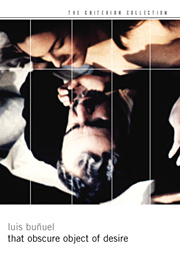
Cet obscur objet du désir

A film by Luis Buñuel, adapted from the novel La femme et le pantin by Pierre Louys.

Recounted in flashback to a group of railway travellers, the story wryly details the romantic perils of Mathieu, a wealthy, middle-aged French sophisticate who falls desperately in love with his 19-year-old former chambermaid Conchita. Thus begins a surreal game of cat-and-mouse, with Mathieu obsessively attempting to win the girl's affections as she manipulates his desire for possession, each vying to gain absolute control of the other.

Deeply rooted in cinematic symbolism and brimming with subversive wit, this bizarre film takes a satiric aim at a decadent, decaying society riddled with political unrest and moral bankruptcy. It was Buñuel's last film and is most noted for the director's use of two actresses (Carole Bouquet and Ángela Molina) to portray the different emotional aspects of the part of Conchita.

I first saw this film at University of York, shortly after its release in 1977 – thirty years later, it is just as surreal as I had remembered. A superb, if unusual film, That Obscure Object of Desire is a fascinating, humorous and poignant study of the obsessiveness behind relationships, surrounded by absurd, strange and inexplicable events.

19 August 2008

Les Passages

A film by Donna Vermeer

A year after a turbulent break-up gamine filmmaker Catherine flees New York for Paris, the city of her teenage dreams, remembering it as super-cool like 60s genre movies or mysterious and tragic like 19th century French novels. Hoping to lose herself in the anonymity of another city, she convinces her crew and her photographer daughter Claire to help her shoot her very American movie in Paris, because "Paris suburbs remind me of New Jersey". Upon arrival she sets out to invent both the New Jersey landscape of her childhood and the Paris (long out of fashion and memory) of the boulevards and snack bars and arcades, with poets in Montparnasse cafés and card games in the wooden galleries of the Palais-Royal. Throwing herself into the production of her movie by day and wandering the streets flâneur-like by night, she is determined to forget the past. But a chance meeting in the flea market at Clignancourt with the beautiful Anna, the actress playing her mother in her movie, sets her life, and heart, on another course.

As Catherine struggles with the ending of her film and Claire's increasing independence, Claire begins her own love affair – with Mathieu, the first Frenchman to pull up on a motorcycle and deconstruct the camera obscura. The film plays with time: the present, in which the story follows these three women as they form a complex love triangle; the past, through the window of childhood memory; history, always with us, always present; and the love story, which is out of time and which follows a path that is always possible to interpret according to a causality or a finality. Les passages allows us to enter two worlds – the one before us and the one that has vanished. Less concerned with plot than mood and emotion, this fragile story starts with a jolt, and ends with an affirmation.

Les Passages is about memory, and dreams, and false starts. It is inspired by Walter Benjamin's The Arcades Project, a collection of fragments about the 19th century Paris passages couverts and what he called "the fate of art".

14 August 2008

Silent Light

Stellet Licht
a film by Carlos Reygadas

Set in Chihuahua in northern Mexico within the Mennonite community, a strict Christian sect of European descent who speak Plautdietsch, a German-Dutch dialect. Johan, the father of five children and a deeply religious man, has fallen in love with another woman, Marianne. Although he is honest about the affair with his wife Esther, openly confessing his adulterous behaviour, he is full of remorse and uncertainty, knowing that he has broken God's laws as he entertains thoughts of abandoning his family. We watch the family in silent prayer, seated at the kitchen table before breakfast. Following their meal, Esther and the children leave the house to begin their day's work in the fields but Johan remains alone at the empty table and in emotional turmoil, his tears begin to flow.

Despite the suffering this love triangle has already wrought on those involved, Johan is unable to put an end to it. His love for Marianne draws him back to her again and again and he is powerless to end the affair. When he drives to the local garage to collect a part for his tractor, he discusses his affair with his friend Zacarías who, whilst philosophical and supportive in a remote sort of way, is unable to accept the burden of problems that Johan has brought upon himself. Suddenly, as a familiar song plays on the radio, Johan gleefully sings along while driving his truck around the yard in circles, clearing his mind of the problems he has been dwelling upon.

Later, he stops at his parents' farm to tell his father about the affair, explaining that he has told Esther about Marianne. His father, a preacher, hints that the devil may be responsible for what has happened, but admits that he also once had an affair with another woman, although he made the choice to bring it to an end.

Johan and Esther take the children bathing in a nearby pool, a gesture of love that makes his infidelity all the harder for Esther to bear. When they are driving alone in a ferocious rainstorm, she begins to speak of her regrets for the happiness they have lost, becoming very upset. She then complains of chest pains and pleads with Johan to stop the car. When he does, Esther runs from the roadside to a neaby tree where she sobs uncontrollably and then collapses.

The film begins in starlight, slowly giving way to the light of the rising sun at the beginning of a new day. Only the ambient sounds of crickets, lowing cattle and the occasional bird cry can be heard, enhancing the perception of serenity and tranquility. At the end of the film the sun is setting and we watch the deepening colours of the sky as the light slowly fades and one by one the stars appear, returning again to the state of tranquility.

An enlightening and engaging exploration of moral and spiritual crises, touching on some profound themes but keeping its emotional distance. While religion is very much a part of the lives of the characters, it is present only in the background of the story. The remarkable cinematography, with the film's unhurried pace and inspired imagery, make it a profoundly spiritual and very moving meditation on love and betrayal.

11 August 2008

The Scent of Green Papaya

Mùi đu đủ xanh
a film by Tràn Anh Hung

Saigon in 1951, and ten-year-old Mùi takes up her new position as a servant in the beautiful house of a well-to-do Vietnamese merchant family. Mùi accepts her place with patience, serving the meals, preparing the vegetables, scrubbing the floors, and polishing the shoes. She performs her duties with great diligence and always with a positive attitude, while carefully observing and taking great pleasure in the smallest details of life around her. With grace and innocence the young girl observes the wonders of the world in everything she sees, loving and caring for all living creatures including insects and frogs.

She is also quietly tolerant of the boorish behaviour and torments of the younger son Tin. Living completely in the here and now, she just observes, judges not, and says nothing. The mother, still mourning the death of her young daughter Tô seven years before, looks upon Mùi as her replacement, a surrogate daughter. Every day Mùi quietly continues her ordinary life, giving every moment all her attention and invisibly enriching the lives of all those around her. One day when preparing a meal for the family, she cuts open the remains of a green papaya to discover the immature seeds inside, representing the potential of the little girl.

Ten years pass and the family fall on hard times as a result of the father who has again left the home, taking with him the family's money. Mùi is sent away to become the housekeeper for Khuyên, a young classical pianist and composer, a family friend for whom Mùi has always held a secret love. Her leaving triggers in the mother a profound sense of loss for her 'daughter' and a sense that the old way of life in her country is coming to a permanent end.

In her new house, Mùi must contend with the musician's Westernised fiancée who personifies the artificiality of modern society. Ever more discontented with the insensitivity of his fiancée, Khuyên sees Mùi with fresh eyes and becomes aware of how much she embodies the traditional values that are missing in his life. As he picks up a bust of Buddha, he realises that the face and the smile of the Buddha are something he has been seeing every day in Mùi. This sudden recognition of her Buddha-nature transforms both their lives.

As she prepares a meal for them both, again we see Mùi cut open a green papaya to reveal inside the immature seeds and we are reminded of the potential of the little girl. Now together, Khuyên teaches Mùi to read and write, which she does diligently, while carefully observing and taking great pleasure in the smallest details of life around her – ever true to both herself and the Buddhist ideal of being in the present moment.

This visually exquisite film with its strong Buddhist theme is itself a meditation. Its rich imagery, symbolism and subtle observations draw us deep within ourselves and remain with us long afterwards. Tràn Anh Hung's debut feature was winner of the Caméra d'Or when it premiered in competition at Festival de Cannes 1993.

8 August 2008

Out of Africa

A film by Sydney Pollack

Out of Africa follows the life story of Karen Blixen, an amazingly strong-willed woman who moves from Denmark to run a coffee plantation with her philandering husband in Kenya around 1914. To her astonishment she soon discovers herself falling in love with the land, its people and a mysterious British adventurer and idealist.

Karen Blixen is the daughter of a wealthy Danish family. When Hans, the man she expects to marry is no longer interested in her, she proposes to his twin brother Bror, both for his friendship and for the title of Baroness, and since she has money he agrees. It is decided they will buy land in Kenya and start a dairy farm. Karen follows Bror out to Kenya where they marry and take up residence but she then finds that her husband has decided on his own to grow coffee instead, even though the land they have purchased is considered too high to support this crop.

When the First World War breaks out and most of the men go south to Lake Natron, Karen leads a long and dangerous supply run to them herself. Learning much about survival, resourcefulness and leadership, she also gains the respect of the men. Her marriage, considered merely one of convenience by Bror, is put to the test when he has other relationships, eventually transmitting syphilis to Karen. After the diagnosis she leaves for Denmark, returning to the farm after a successful though lengthy period of treatment. She decides that Bror must move out for good, which he does, returning only to solicit one last sum of money from her.

Karen continues to develop the coffee plantation, enlisting the local Kukuyu to work on the farm. Eventually much of the tribe is employed by her and she provides them with some of the uncultivated land on which to live. She also builds a school and hires a missionary teacher to educate the children, despite the disapproval of both the tribal chief and many of the English settlers. As a result, she gains a greater understanding of African culture which brings a mutual respect and affection.

Eventually Bror wants to remarry and Karen consents to a divorce. Her long friendship with Denys Finch Hatton, a free-spirited big game hunter, begins to blossom as they are drawn to each other and Karen falls in love with him. He is honest and loyal but lives an independent life of adventure in the wilderness and while Karen wishes for the security of marriage, Denys tells her that he can never give up his freedom – she feels herself to be the one who must pay the price for his freedom.

The coffee plantation is still only barely surviving as she is forced to mortgage it further, but just as success is within her grasp with a first bumper crop, a fire devastates the processing buildings and the entire crop is lost. Having no insurance Karen faces bankrupcy, loses her home and land to the bank, and is forced to sell her remaining personal possessions.

A few days before she is due to leave, Denys appears and offers to fly her in his plane to Mombassa from where she will sail to Denmark. Before he returns for her he is tragically killed when the plane crashes and catches fire. She buries his body on the eastern slopes of the hills overlooking the Great Rift Valley. Her home and lover gone, her life in Africa is over and she leaves, never to return. "I once had a farm in Africa, at the foot of the Ngong Hills."

Karen Blixen returned to Denmark and went on to write a number of books about her adventures in Africa under the pseudonym Izak Dineson.