24 February 2009

Blind Chance

A film by Krzysztof Kieślowski

Blind Chance (Przypadek) explores the interplay of chance and coincidence in the fate of Witek Długosz, a medical student on special leave, living in Łódź, Poland during the politically turbulent late 1970s. We are shown how chance plays a leading role in the changing of destinies for better or worse, in both subtle and dramatic ways. We also see that the same moral choices confront each of us in our lives, albeit in different forms. The film is structured in three parts, each representing a different outcome of a single chance event.

Witek is a young man in search of a direction in life who wants to do good. As the film opens we see him seated on a plane. His eyes suddenly widen in horror and he screams "No!". A bloodied body is dragged across a hospital floor. We are then shown fragmented glimpses of Witek's life as a child, as an adolescent, and as an adult attending medical school. Losing his vocation and following the death of his father, he seeks to define himself through commitment to a cause and decides to go to Warszawa. At the beginning of each of the following three scenarios, Witek is running to catch a train...

Witek almost collides with a man who is drinking a glass of beer. He runs after the train and is just able to grab the handrail of the train's last coach, pulling himself aboard. On the train he meets and befriends a middle-aged Communist veteran named Werner whose political ideals inspire Witek to join the Communist Party in the hope that it will enable him to improve his society. By chance Witek meets up with his first love, Czuszka, who is angered and disappointed by his decision to join the Party which she distrusts. Now a Communist Party member as well as an atheist and idealist, Witek is sent to end a protest by the inmates of a drug rehabilitation centre where the doctors have been replaced by heavy-handed and unsympathetic Party staff. But Witek has little idea of the extent to which the morally corrupt system will affect not only his freedom but of those he loves. When he is questioned about Czuszka's role in the underground activity Witek senses no danger. When Czuszka is suddenly arrested, he realises with a shock that he has been unwittingly turned into an informer, a development that destroys his relationship with her. As he waits to board a plane for a conference in Paris with a group of Party members, they are told at the last moment that they will have to remain in the country to deal with a series of strikes that have broken out.

Witek crashes into a man who is drinking a glass of beer. They collide with such force that he knocks the glass from the man's hand and it smashes on the floor. Witek doesn't stop to apologise, but he misses his train when his path is blocked by a station guard. In the ensuing scuffle, Witek is arrested and subsequently sentenced to thirty days' jail and community service. There he meets Marek, an Opposition activist and soon Witek joins the Opposition, becoming involved in the printing of dissident publications during the strikes and rise of the trade union movement in Poland. Deeply impressed by a woman dissident's tranquil faith in God, Witek decides to be baptised and becomes a Catholic. As the romantic idealist, he yearns to improve his society by adopting the religious and political beliefs of those whose courage and conviction he admires. Witek applies for a passport to travel to France to attend a gathering of Catholic youth in Paris, but his request is refused because of his anti-Communist activities. The authorities however offer to give him a passport if he informs on the underground's contacts in Paris but Witek chooses not to go. He meets up with Daniel, a friend from his childhood who is attending his mother's funeral with his married sister Werka. As a result of this chance meeting, an affair develops between Witek and Werka and she visits his home in Łódź. After her return to Warszawa, Witek discovers that the printing shop has been raided in his absence and his colleagues arrested. Marek holds him responsible and suspects him of betrayal. Finding himself betrayed, he can only conjecture that Werka had something to do with it, perhaps unwittingly.

Witek nearly runs into a man who is drinking a glass of beer, just managing to avoid a collision. He tries to catch the departing train but fails. The railway guard appears a few seconds later but now Witek has stopped to catch his breath. He then notices Olga on the platform, a girl from his medical school who has come to see him off. Happily for Witek, in failing to catch his train, he finds fulfilment instead in both his personal and professional life. Witek and Olga fall in love and Witek decides to resume his medical studies. After graduating he practises at the hospital as well as teaching at the medical school. Olga tells him she is three months pregnant and they get married. Witek leads a happy life as a loving husband and father and also shows great compassion in his career as a doctor, but he steers clear of both religion and politics. At the medical school some students are circulating a petition protesting the arrest of fellow students, including the Dean's son, who have been involved in Samizdat and other dissident activities. Not wishing to jeopardise his career and personal happiness Witek refuses to sign the petition, noting that the Dean himself has not signed either. That evening, the Dean asks Witek to give a lecture in Libya, which on account of his son's arrest he is unable to do himself. Witek agrees to give the lecture but postpones his journey in order to celebrate his wife's birthday, exchanging his ticket for a flight to Libya via Paris. As if seized by a premonition, Olga begs her husband not to go on the trip and when they are at the railway station, surprises him with an announcement that they will soon have a daughter. When he arrives at the airport, Witek sees some of the characters who appeared in the previous two scenarios and we realise that Witek, in the other two variations of his life, would also have been on the same flight had chance not intervened in each case. The plane taxies along the runway, Witek gets comfortable in his seat and the plane takes off. A few seconds later the plane explodes.

Kieślowski described the film as "a description of the powers which meddle with our fate, which push us one way or another". Blind Chance is driven by political undercurrents, and on one level it considers, in 1981, three possibilities for Poland's political future as it explores three different outcomes springing from the premise of a student trying to catch a train. But more profoundly, it explores what Kieślowski termed "interior liberty", transcending the immediate, external political situation to consider the individual's choice in possible courses of action or inaction. Kieślowski's interest lay in a deep awareness of, and sensitivity to, that dimension of life which influences human events, yet for which there is no rational explanation. Ultimately, on the flight to Paris, the same fate awaits Witek regardless of the choices he has made or what has happened to him in between.

In the Danish television documentary Krzysztof Kieślowski: I'm So-So... in 1995, Kieślowski observed, "We are a sum of several things, including individual will, fate (but we can change fate a little), and chance, which is not so important. It's the path we choose that is crucial".

14 February 2009

Faubourg Saint-Denis


A short film by Tom Tykwer for Paris, je t'aime. After mistakenly believing that his girlfriend, a struggling actress, has broken up with him, a young blind man laments on the growth and seeming decline of their once joyful relationship.

There are times when life calls out for a change. A transition. Like the seasons. Our spring was wonderful, but summer is over now and we missed out on autumn. And now all of a sudden, it's cold, so cold that everything is freezing over. Our love fell asleep, and the snow took it by surprise. But if you fall asleep in the snow, you don't feel death coming. Take care.

Francine... I remember it exactly
It was the 15th of May
Spring was late to arrive and rain clouds were gathering
And you were screaming

And of course you were accepted
You left Boston and moved to live in Paris
A small apartment on the rue du Faubourg Saint-Denis
I showed you our neighbourhood, my bars, my school
I introduced you to my friends, my parents
I listened to you as you learned your lines
I listened to your singing, to your hopes, your desires
I listened to your music
And you listened to mine
You listened to my Italian, my German, my bits of Russian
I gave you a walkman and you gave me a pillow
And then one day, you kissed me

Time passed, time flew
And everything seemed so easy, so simple, free
So new and unique
We went to the movies
We went dancing, shopping
We laughed, you cried
We swam, we smoked, we shaved
From time to time you screamed, without reason
Sometimes with reason
Yes, sometimes with reason

I walked you to the Conservatory
I studied for my exams
I listened to your singing, to your hopes, your desires
I listened to your music
And you listened to mine
We were close, so close, ever closer
We went to the movies, we went swimming
We laughed together, you screamed
Sometimes with reason, and sometimes without
Time passed, time flew

I walked you to the Conservatory
I studied for my exams
You listened as I spoke Italian, German, Russian, French
I studied for my exams
You screamed, sometimes with reason
Time passed without reason
You screamed without reason
I studied for my exams
My exams, my exams, my exams
Time passed
You screamed, you screamed, you screamed

I went to the movies
Forgive me, Francine

***

Parfois, la vie exige un changement. Une transition. Comme les saisons. On a eu un printemps merveilleux, mais l'été est fini maintenant et nous avons manqué l'automne. Tout d'un coup il fait froid, si froid que tout se met à geler. Notre amour s'est endormi et la neige l'a pris par surprise. Et si tu t'endors dans la neige, tu ne sens pas la mort venir. Prends soin de toi.

Francine... Je m'en souviens exactement
C'était le 15 mai
Le printemps tardait, la pluie menaçait
Et tu criais

Et tu étais admise bien sûr
Tu as quitté Boston emménager à Paris
Un petit appartement dans la rue du Faubourg Saint-Denis
Je t'ai montré notre quartier, mes bars, mon école
Je t'ai présenté à mes amis, mes parents
J'ai écouté les textes que tu répétais
Tes chantes, tes espoirs, tes désirs, ta musique
Tu écoutais la mienne
Mon italien, mon allemand, mes bribes de russe
Je t'ai donné un walkman, tu m'as offert un oreiller
Et un jour, tu m'as embrassé

Le temps passait, le temps filait
Et tout paraissait si facile, si simple, libre
Si nouveau et si unique
On allait au cinéma
On allait danser, faire des courses
On riait, tu pleurais
On nageait, on fumait, on se rasait
De temps à autre tu criais sans aucune raison
Ou avec raison parfois
Oui, avec raison parfois

Je t'accompagnais au conservatoire
Je révisais mes examens
J'écoutais tes exercices de chant
Tes espoirs, tes désirs, ta musique
Tu écoutais la mienne
Nous étions proches, si proches, toujours plus proches
Nous allions au cinéma, nous allions nager
Rions ensemble, tu criais
Avec une raison parfois, et parfois sans
Le temps passait, le temps filait

Je t'accompagnais au conservatoire
Je révisais mes examens
Tu m'écutais parler italien, allemand, russe, français
Je révisais mes examens
Tu criais, parfois avec raison
Le temps passait sans raison
Tu criais sans raison
Je révisais mes examens
Mes examens, mes examens, mes examens
Le temps passait
Tu criais, tu criais, tu criais

J'allais au cinéma
Pardonne-moi, Francine

9 February 2009

À la folie... pas du tout

A film by Laetitia Colombani

Angélique, a young, gifted art student is in love with a 35-year-old cardiologist named Loïc. The only problem is that the object of her affections is not only a father-to-be but is also happily married to someone else. But when you are madly in love and desire something enough, nothing will stand in your way.

First we see Angélique's attempts to make Loïc leave his pregnant wife, but he does not appear for the arranged meetings, or finally for the planned and booked journey to Florence. The narrative is then reset to the beginning, showing the viewpoint of Loïc relative to the same sequence of events – and things seem quite different now. The film uses restricted editing to show the two perspectives and in the end the two versions converge with surprising consequences.

Angélique is completely delusional about everything that happens. At the beginning we see her with a rose. We see the light of love and romance in her eyes. She thinks, and makes us believe, that Loïc is her lover. Later in Loïc's version we see that he only vaguely remembers handing a rose to a pretty young girl, a stranger, from a large bouquet bought for his wife to celebrate her pregnancy.

Described as an amazing psychological thriller masquerading as a trite romance, He Loves Me... He Loves Me Not is a provocative and unsettling study of amour fou. A taught, complex, and cleverly presented tale of the passion and obsession of a girl afflicted with the rare disorder de Clérambault's Syndrome, who will stop at absolutely nothing to actualise delusion.

15 January 2009

Pora umierać

A film by Dorota Kędzierzawska

Time to Die is the story of the elderly Aniela and her life in what once was a grand and beautiful house. During the Communist regime she was forced to share her home with other comrades, but as the last of them leaves her house Aniela is left alone with only her border collie, Philadelphia, her attentive and constant companion. Her 50-year-old son, Wituś, occasionally visits, accompanied by his overweight 10-year-old daughter who Aniela finds a spoiled, demanding and undisciplined brat. Aniela blames her daughter-in-law, Marzenka, for her son's and granddaughter's laziness.

To one side of her lives a family who host a rather noisy children's music club that Aniela spies on daily and she is often taunted by and bothered by the local kids. On the other side is a nouveau riche couple, apparently scheming with Aniela's cold-hearted and greedy son to buy her old timber house, demolish it and build a modern apartment building on its site. Everybody it seems wants Aniela's house, or her land, so she finds a way to outsmart them all. Aniela is no fool – as she spies and learns of her neighbours' ways and true intentions she is always ahead of the game, and some surprises may yet be in store for those who are not wise to her thinking and abilities.

Throughout much of the film, which is shot entirely in black and white, we follow Aniela inside her house, with fractured views at the hostile world outside through its multitude of unevenly-glazed windows. There are also soft-focus slow-motion scenes in which the young Aniela is seen dancing in the moonlight as a young bride or playing with her young son, recalling the wonderful memories of her younger days. In the end Aniela comes to terms in some way with the difficulties she faces and makes peace with those who deserve to have peace made with them.

7 January 2009

Jestem

A film by Dorota Kędzierzawska

Kundel is an eleven-year-old boy who escapes from an orphanage to return to his home town. There, his young alcoholic mother disowns him and kicks him out. He is also rejected by the other kids who call him "Mongrel", but undaunted and resolute, he finds an abandoned barge in which he makes a home for himself. Kundel is not only a very resourceful child with a strong survival instinct, he is also a fundamentally good person, being especially sensitive to creatures weaker than himself. He then meets Kuleczka, a pretty girl of his own age, from a well-off family living in a house nearby, and soon they discover a sense of affection and love in each other's company. Kundel forages, collecting scrap metal which he sells in town, while he dreams about being a poet one day – and he is marginal and independent enough to create his own wholly separate world, at least for a while.

Jestem (I am) tells the story of a boy searching for his place in life, his identity, whilst trying to avoid both the social pressures of his peers and the de-personalising life of the state-run institution. The splendid cinematography, with soft-coloured sepia-toned images, gives a comforting warmth to this beautiful film and Michael Nyman's musical score is both a sweeping and intimate addition. Writer and director Dorota Kędzierzawska, who has an extraordinary way with child actors, based Kundel, the main character of this award-winning film, on a real child she met who lived in the woods and dreamed of being a poet.

4 January 2009

Helen

A film by Christine Molloy and Joe Lawlor

Helen is a 17-year-old girl with a complex and troubled past who has lived in care since she was an infant. She is on the threshold of her 18th birthday, which signals the end of her care order, and she awaits this new beginning full of anticipation and anxiety, knowing that her entry into adulthood is something she must ultimately undertake alone. Given everything that has happened to her in her life, being left alone is Helen's greatest fear, and her greatest challenge to overcome.

At the same time, and in the same city, there is a missing girl called Joy. A fingertip search led by the police is being carried out in a local woods following the discovery, the day before, of a jacket and personal effects belonging to Joy who has been missing for some time. Until now, Joy's parents have been clinging to the belief that her disappearance was nothing more than a teenage girl's cry for help, and they have lived in hope that one day soon she will return home safely to them. Although not hopeless, the situation following this new development looks somewhat more ominous.

A police reconstruction is organised that will retrace Joy's last known movements, to be screened on national television in the hope that it will provide valuable clues as to what happened to Joy in the twenty-four hours leading up to her disappearance. Helen is chosen to play the part of the missing girl in this reconstruction and both the police, and especially Joy's parents, agree that Helen is the perfect choice for the role. But the parents sense that there is something uncanny about Helen's resemblance to their daughter and are slightly unnerved by the similarity. Somehow their encounter with Helen makes them even more vulnerable and it is clear that they might actually need her help to get them through this very difficult time in their life. What they do not know is that Helen also needs their help.

For Helen, the role of stand-in represents an important opportunity, and she senses that to inhabit someone else's life, if only temporarily, could help her with her own life. Joy, who is the same age as her, had many of the things she never had: a secure home; loving parents; success at school; popularity amongst her peers; and a steady boyfriend. Gradually Helen begins to immerse herself into the role, visiting the people and places that Joy knew; quietly and carefully insinuating her way into the lost girl's life. But is Helen trying to find out what happened to Joy that day, or is she searching for her own identity?

1 January 2009

Valley of Flowers

A film by Pan Nalin

Along the highest mountain passes of the Himalaya, the intrepid Jalan and his gang of outcasts make their living by robbing unsuspecting travellers. Abiding by their own unique codes of honour and dividing the spoils equally, all is routine until the arrival of the mystifying, beautiful Ushna. Appearing mysteriously after the raid of a pilgrim caravan, Ushna adheres to Jalan, claiming to have seen him in her dreams, and refusing to leave his side. Sensing the unease of the rest of the men, Ushna offers to help them in their endeavours, on condition that they do not ask why or how she is able to guide them to success.

In the time that follows, Ushna leads the gang to tremendous exploits, gaining the respect of the men, and the admiration of Jalan, who begins to fall passionately in love with this mysterious woman. As their success increases, seemingly unstoppable, so the love between Jalan and Ushna mounts in intensity, until they seem to have entered a world of their own. No longer heeding of the world around them, Jalan and Ushna venture too far in their exploits, progressing from the theft of material objects to tampering with the elements of nature – stealing energy, fortune and even the powers of levitation – the two cross over into the bounds of the supernatural.

Word of the duo and their strange exploits reaches the shrewd Yeti, who goes after them with his three bounty hunters. In the confusion of pursuit, Jalan and Ushna face a temporary separation, the shock of which drives each to desperation. Having lost luck, wealth and friends, the fated two are nevertheless fortuitously reunited. Their passion running higher than ever, they vow never to be separated again, even if this entails deceiving fate and cheating mortality. But life always reserves surprises, and karma will eventually restore the balance and their destinies, but in the most unexpected ways.

The story, Valley of Flowers, is inspired by an incident mentioned in Alexandra David-Néel's Magie d'Amour et Magie Noire where she narrates her meeting with an Indo-Tibetan highwayman. This bandit-chief in his youth had a passionate love affair with a beautiful young woman whom he believed to be an incarnate demon. Their adventure took them right across Tibet through the wildest and most inaccessible Himalayan regions and brought them into contact with some fascinating and mysterious people. Their extraordinary journey as Alexandra explains in her book is "a true story which has been lived".

A magical Himalayan tale of love and longing, karma and reincarnation, death and immortality, spanning two centuries, from the Silk Route of the early 19th century to the bustling metropolis of modern-day Tokyo.

30 December 2008

The Singing Detective

A TV mini-series written by Dennis Potter and directed by Jon Amiel.

Detective novelist Philip Marlow suffers from the crippling condition psoriatic arthropathy. Incapacitated both physically and emotionally whilst confined to a hospital bed, Marlow escapes into his imagination, plotting out a murder tale in which he is both a big-band singer and a private eye. As he re-writes his early crime noir thriller, The Singing Detective, he enters into a surreal Chandleresque fantasy of sleazy nightclubs, spies and criminals.

In his hospital bed where he rants and yells at everyone who comes near him, Marlow begins to hallucinate from his high fever. Reality and fantasy constantly overlap and intertwine as the story weaves effortlessly between his present experiences, his past fictions, paranoid imaginings, and the overwhelming memories that still dominate his life from his childhood, growing up amongst a poor, ignorant coal-mining family in the Forest of Dean.

Escaping into this dark inner world, he places himself in the role of the hero of his own novel, and so begins to encounter and explore the guilt he has carried from his tormented childhood days, and the paranoid fantasies he has about his estranged wife Nicola. As he drifts between memories of past events and the mental re-working of his novel, all surfacing in his subconscious, Marlow's tortuous self-analytical voyage of personal discovery provides a key to the conquering of his illness.

A dramatically rich and complex masterpiece, disturbing and shocking, yet also with great depth of insight and humour – a uniquely brilliant work.

24 December 2008

Caché

Hidden
a film by Michael Haneke

Georges, a television presenter, and his wife Anne, who works at a publishing house, are living the perfect life of modern comfort and security. But their successful bourgeois lives hide a complacency and general indifference to the outside world.

One day, their idyll is disrupted in the form of a mysterious videotape that appears on their doorstep. On it they are being filmed by a hidden camera from across the street with no clues as to who shot it, or why. At first Anne is dismissive of the tape, which appears to be surveying the exterior of their home, but Georges believes there is a sinister motive behind its unexplained appearance. Soon they receive a second tape accompanied by a disturbing drawing. Nerves become frayed and tension erupts when their twelve-year-old son Pierrot, staying at a friend's house all night without letting them know, brings fears that he has been kidnapped by the stalkers.

A third tape reveals the farmhouse where Georges grew up and where his invalid mother still resides. A visit to his mother brings back long buried memories and he is forced to confront a terrible secret, hidden since his childhood. As he begins to fear for the safety of his family, and as Anne struggles to come to terms with his revelations, their entire comfortable existence begins to disintegrate. Convinced he knows the identity of the person responsible, Georges embarks on a rash and impulsive course of action that leads to shockingly unexpected consequences.

The story is multi-layered – on one level it is a study of the colonial guilt of Europe and race relations; on a deeper level it probes the complacent and bourgeois temperaments of the financially secure classes in society; on yet another level the story explores the attitudes of three distinct generations towards social relationships. A brilliantly conceived and intriguing film, the voyeuristic camera lingering on long static shots as images pass across both foreground and background, enabling us to interpret things at our will.

It is a story about the propagation of lies to avoid confronting the guilt that remains for our past actions – and how we find ourselves ever more enmeshed in that from which we seek to escape. Haneke shows us that we all have things we want to keep hidden, but can we be sure that we are the sole keepers of our secrets? Ultimately he leaves us to decide what the truth is, or indeed whether it is not perhaps better for the truth to remain hidden.

11 December 2008

Nadzieja

A film by Stanisław Mucha, from the screenplay trilogy Heaven, Hell and Purgatory by Krzysztof Kieślowski and Krzysztof Piesiewicz.

Nadzieja (Hope) is the last film in a trilogy representing not only the Dantesque concepts of heaven, hell and purgatory, but also the Christian ideals of love, faith and hope. As the film opens we witness a woman being killed in a road accident as she attempts to protect a child's life. She was the mother of the child, Franciszek. Franciszek's father, a renowned musician and conductor, still suffers from his bereavement fifteen years later, having given up his music to become a humble church organist. Franciszek's suicidal older brother, Michal, is currently serving a prison sentence for the murder of two men.

Set in contemporary Warszawa, Franciszek, an angelic-looking young man, has been following the underworld events in the life of Benedykt Weber, a senator, gallery owner and respected art dealer. He has compiled a complete dossier on all of Weber's dealings and knows everything about the man's life. One night Franciszek lies in wait in the same church where his father now plays, to capture with a borrowed videocamera, Weber's theft of a magnificent 15th century Venetian altarpiece called 'Angel with a Violin'. With this video and other supporting evidence Franciszek approaches Weber, making it clear to him that the dossier will be given to the police if he does not return the painting to the church. But instead of trying to extort money from him, Franciszek simply says that he wants to help him.

Weber quickly realises that Franciszek has the means to both destroy his valued reputation and to put him in prison if he does not comply with the boy's request. But already the painting has passed to another intermediary in the underworld of art theft and it will now be impossible to get it back, yet Franciszek is insistent that the painting be returned, despite several warnings being given in an attempt to frighten him off.

We begin to see that Franciszek has no sense of fear. During his freefall flights at the airfield he waits longer and longer before he opens his chute. It's as though in all he does he is protected by angels. But his girlfriend Klara, who loves and admires him even though he does not return her affection, becomes increasingly unable to bear the risks he now takes. There is also the question of whether forcing someone to undo a wrong is of any use if in reality the person simply fears the consequences of not making amends.

Mucha allows the story to unfold as a combination of thriller, moral tale, and metaphysical drama, recalling the films Piesiewicz made with Kieślowski. Likewise, there is a similar sense of cosmic order and chaos, with many elements seemingly mysteriously connected, yet unexplained. Whilst the film focuses on hope, it does so not in any conventionally uplifting way, but rather by an exploration of the capacity of the human spirit.

8 December 2008

L'enfer

A film by Danis Tanović, from the screenplay trilogy Heaven, Hell and Purgatory by Krzysztof Kieślowski and Krzysztof Piesiewicz.

In Paris in the 1980s, a man, fresh from his release from prison, is rejected by his wife. After a violent confrontation he throws himself from his apartment window, witnessed by his three young daughters. In present day Paris, the sisters, now grown up, live their own lives – the family bonds are broken. Sophie, the eldest, is married with young children, but suspects her photographer husband of having an affair. The youngest sister, Anne, is a student involved in a messy relationship with one of her tutors. Middle sister Céline lives a solitary and joyless life, caring for her difficult mother. When a young man starts to take an interest in her, she little suspects the true motive behind his approaches.

An intricate tragedy of three sisters, each now with problems in their adult love life, primarily derived from their mother's mistaken understanding of their father's "sexual misbehaviour". The terminally unhappy Sophie is intent upon discovering the truth behind her husband Pierre's loss of affection for her. Anne, seeking the stability and reassurance of a father-figure in her affair with Frédéric – a married Sorbonne professor and her best friend's father – finds her world has been shattered when he tells her he cannot see her again. Céline, a repressed spinster, longing for companionship but devoting her life to the needs of her institutionalised mother, misinterprets the sudden interest a young man, Sébastien, shows in her.

The reference to Medea, the tragedy of tragedies in Greek mythology, parallels the elements of misunderstanding, deceit, vengeance and unforgiveness surrounding the three women haunted by a nightmarish childhood experience. Each of the sisters lives in her own private hell, separated from her siblings. Only when the truth about their father's prison sentence for seducing a young male student is finally revealed, do the family reunite in a final attempt to understand, and come to terms with, their past.

An intense and riveting drama, subtly crafted and portrayed. The film includes a few delightful little cameos, most notably one involving an elderly lady at a bottle-bank. Tanović's realisation of the original screenplay (of which he expressed surprise at its having been written by two men) is an absolute delight. He dedicates his film simply and affectionately: à KK.

3 December 2008

Heaven

A film by Tom Tykwer, from the screenplay trilogy Heaven, Hell and Purgatory by Krzysztof Kieślowski and Krzysztof Piesiewicz.

Philippa, a British teacher living in Turin, Italy, has watched helplessly as her husband and friends have fallen victim to drug overdoses. To compound her desperation, the Carabinieri – who are complicit in the actions of Turin's biggest drug dealer – have completely ignored her repeated offers of information.

We follow Philippa as she assembles a bomb and places it in the office of the drug dealer, and then confesses her crime by telephone to the police, forty seconds before the bomb is due to explode. Having witnessed the loss of so many innocent young lives at the hands of this man, she feels this to be the only course of action left to her, and is willing to pay the price for what she is doing.

During her interrogation following arrest, it is revealed to her that her plan has gone terribly wrong and that instead of the intended victim dying, four innocent people including two children have been killed in the explosion. The police are convinced she is part of a terrorist group and refuse to accept her reasons for the attempted murder of the drug dealer. With the unexpected help of Filippo, a sympathetic young police officer, she escapes detention and is given a second chance to kill her victim, and with nothing to lose she takes divine justice into her own hands.

A probing exploration of the modern world and its moral choices, in which we witness Philippa's transformation from a grieving widow to a wanted fugitive on a journey through retribution, redemption, innocence and crime. A mesmerising art film, full of refined camera work and scarce in dialogue, with a slowly evolving story of the relationship between two people caught in a nightmarish situation. With magnificent cinematography and breathtaking aerial shots over the Tuscan countryside, it is a subtly told story of fate and destiny.

29 November 2008

Frida

A film by Julie Taymor

The story of an exceptional woman who lived an unforgettable life. Frida Kahlo, born in Mexico in 1907, endured a life of crippling pain caused by a road accident in her youth, yet her innate energy, passion and love of life, as well as her enormous abilities as a painter, allowed her to overcome this daunting obstacle to achieve fame and recognition. From humble beginnings, Frida Kahlo is a talented artist with a unique vision, and from her enduring relationship with her mentor and husband, Diego Rivera, to her scandalous affairs, Frida's uncompromising personality inspires her greatest creations. She is an artist in every sense of the word – taking and owning all that life gives her and transforming it into unflinching portraits of her soul.

Frida, in many ways, prides herself on her independent, fiery nature, yet when Rivera becomes a part of her life, she quickly succumbs to his seductive charms. She marries him even though she knows he is constitutionally incapable of remaining faithful to her. She accepts this in the knowledge of what lies ahead for her since she is incapable of living without him. That the relationship is one of utter co-dependency is demonstrated by the fact that Rivera, even after their numerous breakups, keeps coming back to his one true love.

But we see also, and empathise with, the hypocrisy inherent in her own romantic dalliances, principally her bisexual flings with other women and even the affair she conducts with Trotsky himself during the period of his exile in Mexico, just before his assassination. Frida is a woman who experiences so many tragic things in life yet she never gives up, she in fact grows stronger, helped through hard times by her wit, her dignity and her love for life and art.

Between 1926, when she made her first self-portrait, and her death in 1954, Frida produced around 200 images. Certainly the biographical details of her remarkable life inflect many aspects of her work, yet her depiction of her body and experiences can also be seen as a response to wider cultural and political debates. For all their apparent naivety, her works frequently reveal an incendiary subtext, whether they are questioning power relationships between developed and developing nations, testing the role of women within a patriarchal society, or attempting to reconcile the global histories and religions of East and West.

Frida Kahlo's unique talent was to make her one of the century's most enduring artists. She is variously enshrined in the popular imagination as a bohemian artist, a victim turned survivor, proto-feminist, sexual adventurer who challenged gender boundaries, and, with her mixed-race parentage, an embodiment of a hybrid, postcolonial world.

Adapted from the biography by Hayden Herrera, the film is a marvellous tribute to a truly unique and remarkable woman, and one of the greatest female artists of the 20th century.

16 November 2008

Possession

A film by Neil LaBute

Roland Michell is a laid-back American scholar who has come to London to research the 19th century English poet Randolph Henry Ash. The present year, 2000, marks the centenary of the discovery of Ash's work. While examining a first edition of one of Ash's volumes, Roland discovers some original letters which hint at the possibility that Ash, contrary to the public impression of his marital fidelity, may actually have had an affair with another famed poet of the time, Miss Christabel La Motte, a woman believed by her biographers to have lived exclusively with her partner Blanche. Confronted with this startling, revolutionary and, perhaps, priceless piece of information, Roland sets out to unravel the mystery.

He enlists the help of the sceptical British academic Maud Bailey, an expert on the life and work of Christabel La Motte, and also a distant descendant. The two embark on a journey to unravel the truth surrounding the poets' forbidden love. But as Roland and Maud track the elusive romance across the British countryside to Lincoln and Whitby, the two scholars soon find themselves tangled in a love affair of their own.

The narrative moves seamlessly between past and present to portray the parallel love stories in this beautiful and passionate adaption of the Booker Prize winning novel by A S Byatt.

12 November 2008

Capturing Mary

A film by Stephen Poliakoff

This is the companion to Joe's Palace, set in the same exquisite empty house and is linked by the doorkeeper Joe through whose eyes we see the world.

When Joe opens the door to an elderly lady, she takes him back to a time when the house thronged with the glamourous and powerful – and to a time when she was young, beautiful and talented with the world at her feet.

As Joe takes her through the house Mary begins to relive her relationship with Greville White, a supremely charming man who seems to hold the rich and famous in the palm of his hand. Who was this enigmatic figure? Was he feigning friendship with Mary, but offering something much more sinister and frightening? In a dark and terrifying exploration of her youth, Mary relates a chilling story of a life captured and transformed.

Also included on the DVD is an exclusive prequel A Real Summer in which we see young Mary strike up an unexpected friendship with a young aristocrat Geraldine. An allegorical tale which explores the two aspects of Mary's personality, revealing in juxtaposition her aspirations, achievements and doubts, and the self-acknowledged warning that she will choose to ignore.

7 November 2008

Joe's Palace

A film by Stephen Poliakoff

The story takes place in the exquisite but empty Mayfair house of reclusive billionaire Elliot Graham, who lives a lonely life across the road. When Joe, the naive son of the cleaner, takes the job as the vacant house's doorkeeper, he and Elliot strike up a fledgling friendship.

Soon Joe is given the run of the house, exploring its many rooms and secrets, and providing a convenient refuge for a cabinet minister and his beautiful mistress to conduct a clandestine and passionate love affair.

The house seems to attract lonely people – the doorman whom Joe replaces, the housekeeper, the night security guard, both the cabinet minister and his mistress, the homeless man and Elliot Graham himself. Elliot is increasingly paralysed by his suspicions of the origin of his inherited wealth and when the secret is finally revealed, it is Joe who accompanies the billionaire on his disturbing and devastating journey.

4 November 2008

The Constant Gardener

A film by Fernando Meirelles, adapted from the novel by John le Carré.

British diplomat Justin Quayle meets the impulsive human rights activist Tessa when she heckles him after he has presented a lecture. When she learns that he is about to embark on a diplomatic mission in Kenya she proposes to him in order that she may accompany him as his wife.

In a remote area of northern Kenya, Tessa Quayle is found brutally murdered. Tessa's companion, Dr Arnold Bluhm, appears to have fled the scene, and the evidence points to a crime of passion. Members of the British High Commission in Nairobi assume that Tessa's widower, their mild-mannered and unambitious colleague Justin Quayle, will leave the matter to them. But haunted by remorse and jarred by rumours of his late wife's infidelities, Quayle surprises everyone by embarking on a personal odyssey that will take him across two continents.

Using his privileged access to diplomatic secrets, he will risk his own life, stopping at nothing to uncover and expose the truth – a conspiracy more far-reaching and deadly than Quayle could ever have imagined, involving members of the British High Commission and the sinister business practices of a leading multi-billion dollar pharmaceutical company. In the process of learning the secrets of his powerful enemies, Justin must uncover all of his wife's many secrets as well.

A very poignant and thought-provoking story of conspiracy, deception and treachery.

2 November 2008

The Lost Prince

A film by Stephen Poliakoff

It is 1910. One dynasty holds sway over the most powerful nations of the world, at its heart is the British monarchy and its youngest member, Prince John. A loving, insightful and humorous child, Johnnie is witness to some of the most momentous events in the history of our times. As a baby he is surrounded by the extravagant court of Edward VII and Queen Alexandra at the height of British imperial power. But as the Great War looms his newly crowned father George V and his mother Queen Mary become embroiled in the tumult of world affairs and do not have time to see their special child as he grows. He is prone to epileptic fits and the medical profession consider him to be an imbecile and as such an embarrassment to the family.

As the landscape of Europe changes forever Johnnie is looked after in a remote farmhouse in the Sandringham estate by his devoted nurse Lalla. Dedicating her life to the little boy she determines to remind the monarchy that Johnnie is, at heart, a true prince. A beautiful, moving and heartbreaking deconstruction of the stultifying haze of tradition, refinement and etiquette in which the Edwardian royals lived.

27 October 2008

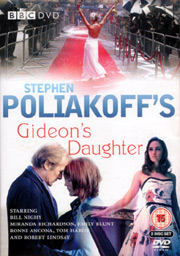
Gideon's Daughter

A film by Stephen Poliakoff

William Sneath, the character from Friends & Crocodiles reappears to narrate a powerful story of success, loss and redemption. "Here is a man who can't listen, and yet the more he doesn't listen, the more people want him, the more people believe in him. He's the toast of Whitehall, the flavour of flavours."

As the century draws to a close, a new Labour Government comes to power, and the death of Princess Diana heralds a summer of flowers. PR guru Gideon Warner finds himself in perfect step with the times and success seems easy as politicians, businessmen and starlets beat a path to his door.

But just as he reaches the pinnacle of his career, Gideon finds his life spinning out of control. When he should be organising the nation's Millennium celebrations, he is focusing on diffusing the implacable anger of his daughter Natasha. And, rather than shaping the business ambitions of an Italian media tycoon, his time is spent falling in love with the eccentric Stella – a mother grieving for her dead son.

Writer and director Stephen Poliakoff imparts an incredible tenderness matched with a hard-hitting candour to this moving story. The sister film to Friends & Crocodiles, it completes a brilliant panorama of the final decades of the last century.

25 October 2008

Friends & Crocodiles

A film by Stephen Poliakoff

The story traces the relationship of a maverick entrepreneur and his colleague over a period of 20 years. It follows the shifting power balance between them as their careers rise and fall through the changing corporate landscape from the beginning of the Thatcher years to the rise of the electronic age and the dot-com bubble.

It is 1981 and Paul Reynolds, a Gatsby-like figure, is the young, wealthy owner of a magnificent country house, a host of great parties, and the patron of eccentrics. He is a collector of interesting people, a visionary with dreams of new urban landscapes, wind power, airships and questions about why the crocodile has survived unchanged for two millennia.

He persuades Lizzie Thomas, a secretary at a local estate agents, to come and work for him as his assistant, to bring some order into his chaotic and hedonistic existence. Once at his country house her world expands – she meets academics, poets, artists, revolutionaries, libertarians and politicians. It is here that she first encounters Sneath, a social chameleon and born survivor, who is always there as events unfold and available to tell the story later.

Paul inspires Lizzie with his enthusiasm and imagination, and frustrates her with his apparent carelessness and destructiveness, which culminates in her calling the police as a great party is turned over by local troublemakers, seemingly with Paul's tacit approval. Paul's Eden seems destined to self-destruct – a terrible row ensues between them and they part company vowing never to speak or see each other again.

Some years later they do meet again, by chance, in London. Following this first awkward encounter their paths are destined to cross again and again as Lizzie, with the help of some of those she met at Paul's house, rises through the changing landscape of corporate Britain and Paul continues to pursue his dreams and create another Eden for himself.

Now that the seemingly unstoppable impetus to change, rationalise and modernise has taken root, technology and everyone is moving on – nothing is permanent or constant. However, eventually one certainty does become apparent and Lizzie and Paul come to accept that despite everything that has happened they were born to work together.

The story is an examination of the nature of personal relationships where work and ideas are more powerful drivers than sexual emotions. In his inimitibale style, Poliakoff combines cinematic panorama with moments of great intimacy as he takes an epic sweep through Britain's recent past and creates an unforgettable story.